Category Archives: GOTY 2012

GOTY 2012 — Matt: Spec Ops: The Line

Since Ricardo decided to write about my personal GOTY pick, The Walking Dead, I’m going to write about my runner-up for 2012. Another game that did an amazing job with its story, choices, and brutal player revelations: Spec Ops: The Line.

Upon first glance, Spec Ops appears to be nothing more than a very generic, third-person, military shooter set in the Middle East. After a late first act turn, however, the game proceeds to flip what you expected on your head, and instead takes you on a slow, spiraling descent down a dark road to madness. Without spoiling as much as I already have, it’s safe to assume that things to do not go well for Capt. Walker and company.

Spec Op’s story not only addresses themes such as the horrors of war and posttraumatic stress disorder, but also is a direct statement on war games, player agency, and those who seek entertainment out of virtual violence.
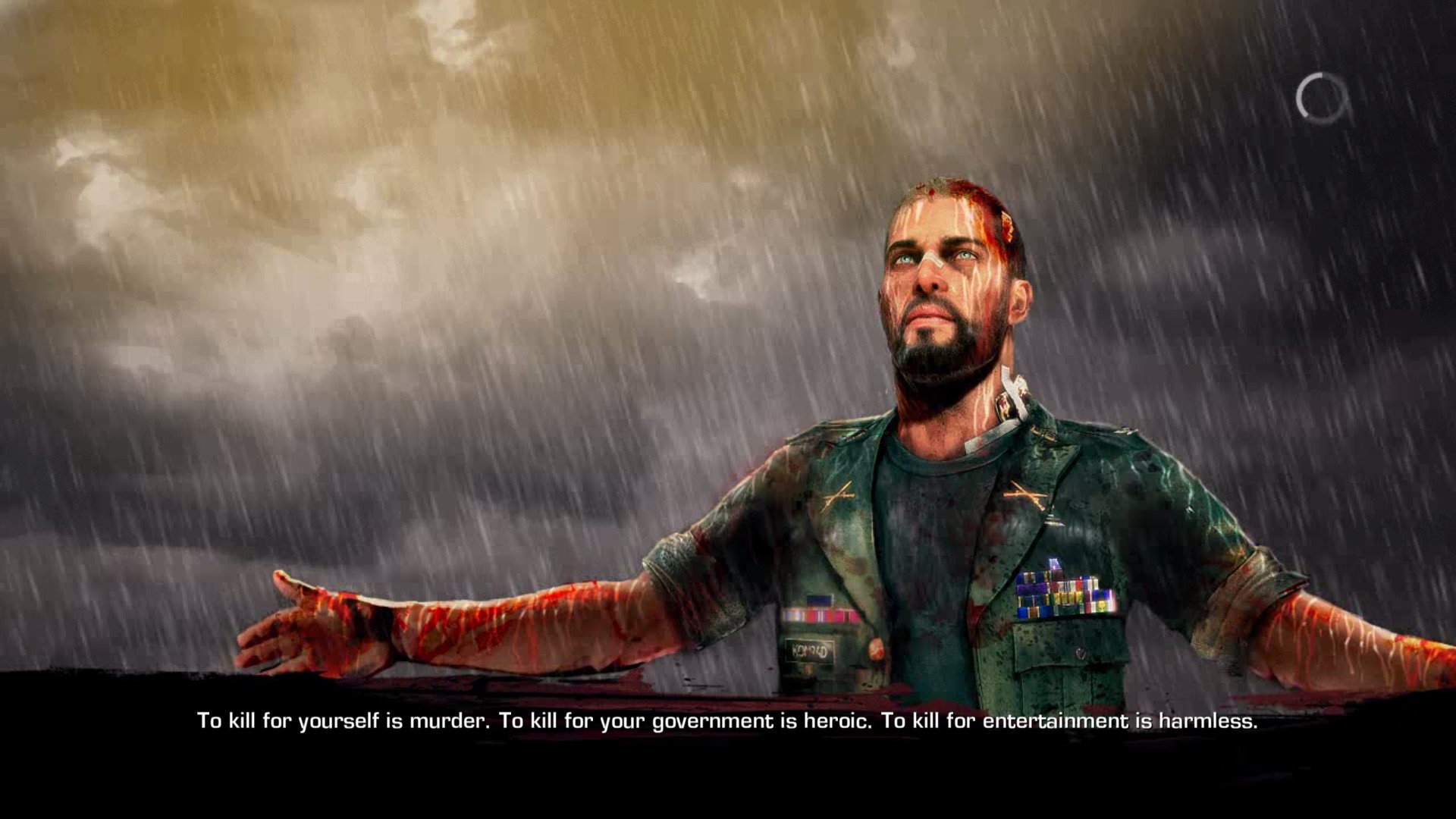
Spec Ops Entertainment

Throughout the game players are presented with “choices” that do have consequences in the main story, but when it comes down to the most important moments of the story, there is no choice. If you play the game, you will do horrible things to proceed, and the game will take note of that. It might seem unfair for a game to ask you to do something and then say you’re a bad person for doing it, but in a world where we’ve become accustomed to being “the one,” the player character who can save the day and do anything no matter what, Spec Ops tells you sometimes you can’t control everything.

According to the lead writer for the game in a series of interviews, Walt Williams, the player does have a choice: He or she can stop playing the game.
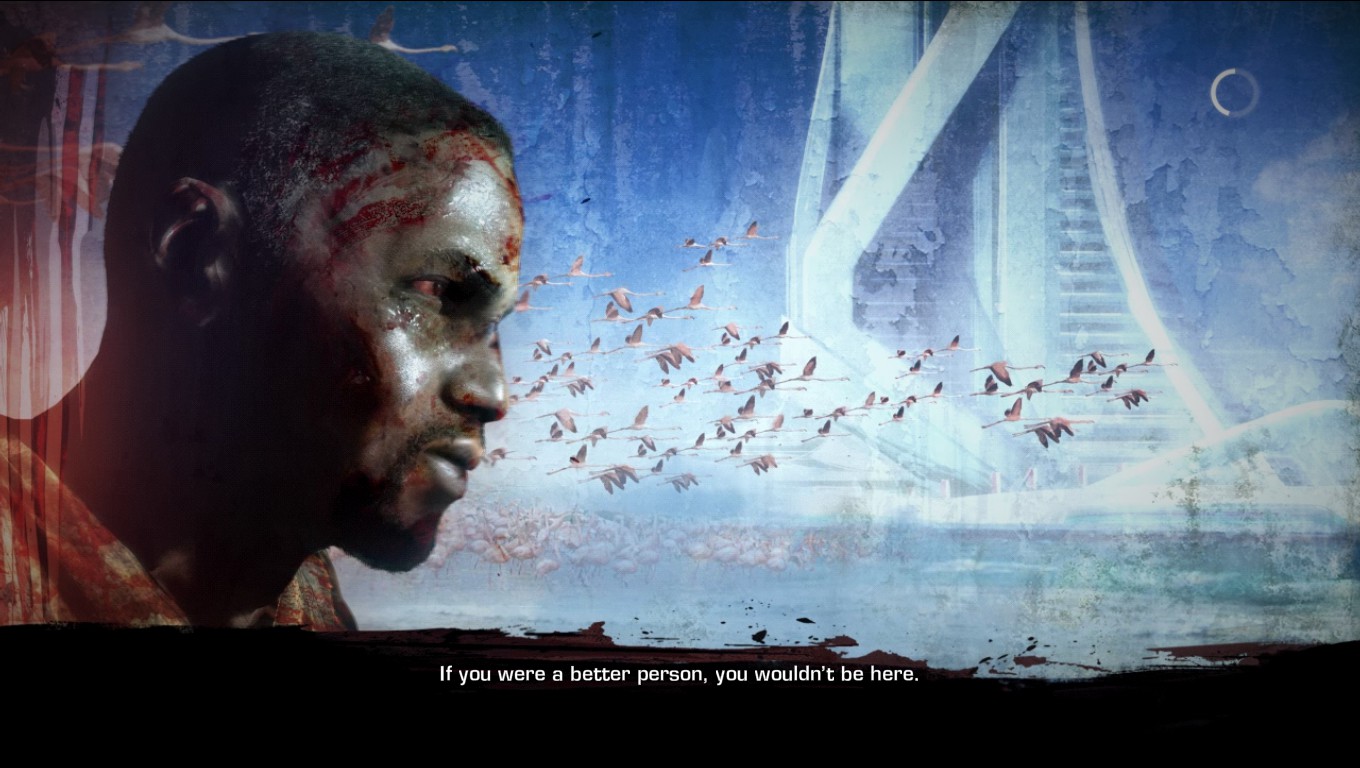
Spec Ops Better Person

Again, the idea seems totally alien, contradictory, and perhaps even nonsensical. At the end of the day Spec Ops perhaps does not have an opinion itself, but is simply asking the questions. Why do we get enjoyment out of virtual violence? Is it OK for us as a society to glorify war and grisly deaths the way modern war games often do? Does the player always have to be able to save the day and make whatever choice they want?

Spec Ops: The Line is by no means a perfect game. In fact the gameplay itself would probably be described as bland. It’s a perfectly competent 3rd person shooter, with some vehicle sequences thrown in. The game flew under many a radar prior to release for not showing off anything that seemed interesting, but the only way it could have shown anything that was interesting would be to spoil its story.

The game relies on shock to convey its message. One could argue how effective some of those moments are, but for the most part I was genuinely moved by the game and its characters. Seeing how the Delta Force team slowly falls apart is incredible. Even small details, like having the character’s “reloading” and other shouts grow more desperate and unhinged as the game progresses create a sense of insanity. By the end of the game even the loading screens are calling you out. “How many Americans have you killed today?”
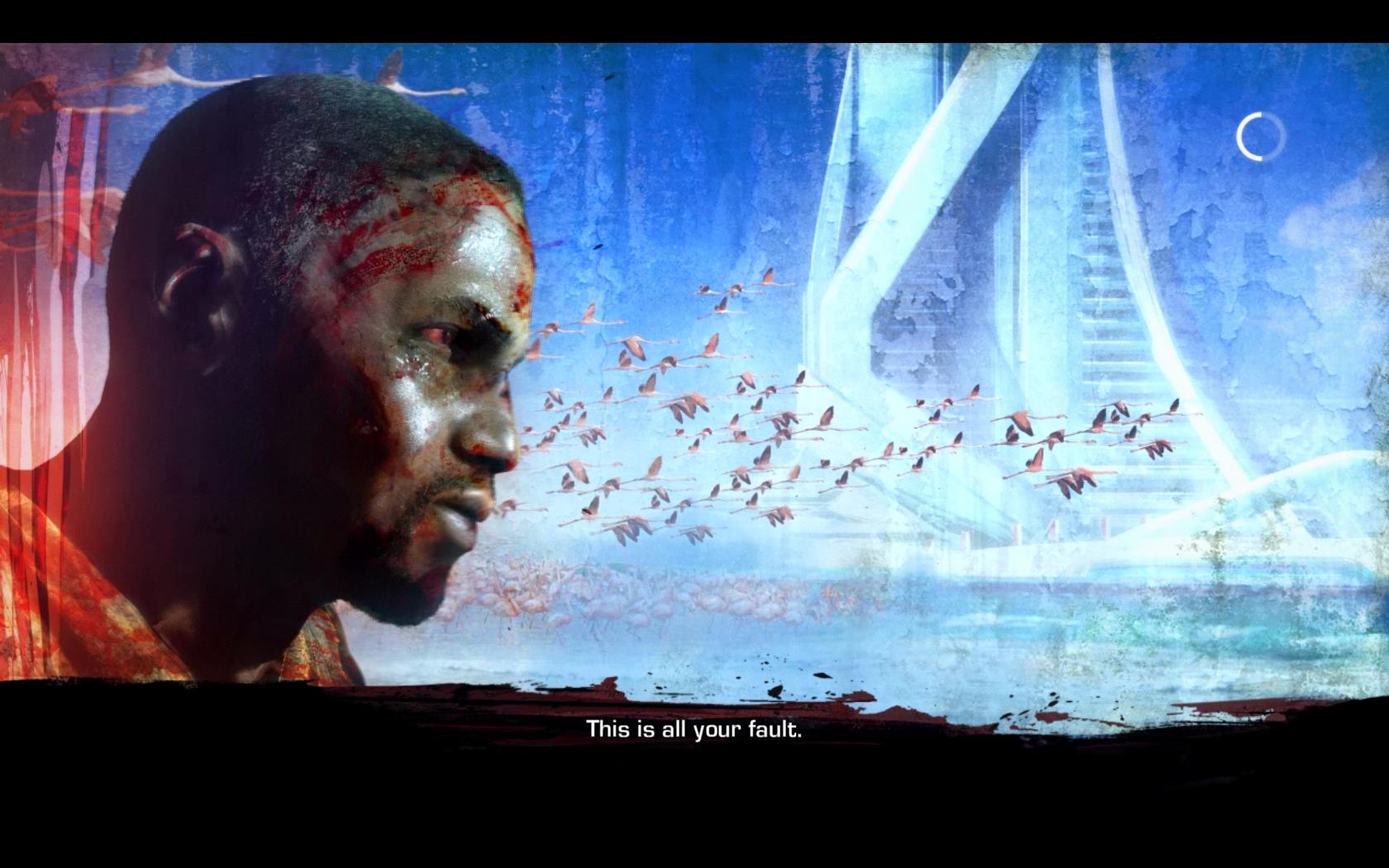
Spec Ops All your Fault

Spec Ops works better as a conversation piece, a work of criticism, than a game. That’s why it’s number 2 on my personal list. But the questions it asks are those that need to be asked. With recent events, people outside our world are asking questions about violence in video games. While I don’t believe video games cause real world violence, there is still room to examine why we view these forms of media as entertainment, and take a hard look at some of the potential problems this entertainment industry has. Knee-jerk reactions and angry shouting at those who disagree won’t help our case.

As for Spec Ops it’s a shame it didn’t quite get the attention it deserves for pointing out some of these things. While there was a brief zeitgeist following the game’s release, discussion on some of it’s larger themes seems to have dried up. Hopefully other games in the future can pick up that torch, and continue to view these important subjects in a nuanced way.

While Spec Ops: The Line may not have been my game of the year, it rides a close second. What it represents is perhaps more important that what it actually is.

GOTY 2012 — Andrew: Borderlands 2

Surprised by my pick? So was I.

While I’ve always enjoyed a great Halo entry, I do not generally consider myself a fan of shooters. If you listen to the podcast, you know my preferences. Give me an open world, RPG, or action/adventure with some interesting characters, and I’m sold. And yet it was Borderlands 2 that called me back once I played through autumn’s Triple-A’s.

Borderlands 2 - Vault HuntersFirst, I must confess. The first Borderlands, although critically acclaimed,  never grabbed me. I wasn’t interested in any of the characters, the story (if you want to call it that) was uninspired and far from compelling, and the alien world of Pandora (at that time) consisted of little more than desert. Granted, I had made the mistake of trying to go it alone, but the seemingly endless loot and stylized aesthetic just wasn’t enough to win me over.

Where the first game fails, however, the second excels. With its larger scope, humorous writing, and greater variety in both its enemies and environments, Borderlands 2 proves that Pandora is worth exploring after all.

Of course, one does not simply walk into Mordor Pandora. Opposition lies behind every corner, and unlike the first outing, that opposition is given a face from the start. “Handsome Jack” is the villain you love to hate. He’s outrageously pompous, unashamedly self-absorbed, and vehemently power-hungry. And yet, much of the game’s most humorous, quotable writing is spewed from his ceaseless mockery.

The odds seem stacked against you, sure, but (hopefully) you’re not in this alone. The four (now five) playable Vault Hunters are as diverse in play style as they are in appearance.  And while their personalities are very much their own, their skills, perks, and abilities remain adaptable to your play style. For the run-and-gunners, the “gun-zerking” Salvador is your man. Me? I appreciate stealth, speed, and finesse. I rolled with Zer0.

Borderlands 2 - Train Wreck

Although the original four vault hunters from the original Borderlands are unplayable this time around, they remain integral parts of the sequel’s story. In fact, their transition into the third person is one of the main story’s greatest assets.  Witnessing them actually interact with each other, now and for the first time, adds both personality to their characters and deeper, more personal exposition.

Addressing another of the first game’s shortcomings, Borderlands 2 allows players to explore some deliciously diverse locales. Although some of the desert remains in “The Dust,” players will travel from the frigid “Frostburn Canyon” to several urban cities, the lush “Highlands,” and the acidic “Caustic Caverns,” just to name a few.

Of course, the foundational allure of Borderlands is found in the game’s vast array of randomly generated loot, varying in everything from clip size and fire rate to elemental effects and precision.  Some are even thrown, exploding upon impact every time the weapon is reloaded. Acid-spewing machine guns? Check. Electric sniper rifles? Check. Some guns may actually speak. Seriously… As in talking. To you. With words.

borderlands2.05.lg

Drop-in drop-out coop is seamless, which is great, considering the game is best enjoyed with friends.  Should you complete a mission after joining another player who is further along in the game, an impressive new feature gives you the option to skip said mission once returning to your game. I hope Bethesda takes note….

Despite some texture pop-in, and rare, random glitches, Borderlands 2 is a perfect balance of frenzied action and depth, offering countless hours of shooting, looting, and leveling, while also sporting a satisfying level of customization and an enjoyable narrative.

“So, you know,” as Jack would say, “That’s cool. Kay, bye.”

GOTY 2012 — Ethan: Journey

Some people love sprawling games that give the player an open world to discover and play with. Some love games with decisions that affect story. Some love games that can be played for hours before getting to the end.

Journey is none of these.

Instead, it foregoes many of the current gaming trends that typically warrant critical acclaim and is better for it. Every section of the game is brimming with diverse and beautiful content, making sure there’s never a dull moment. For me it is pretty much the perfect game.

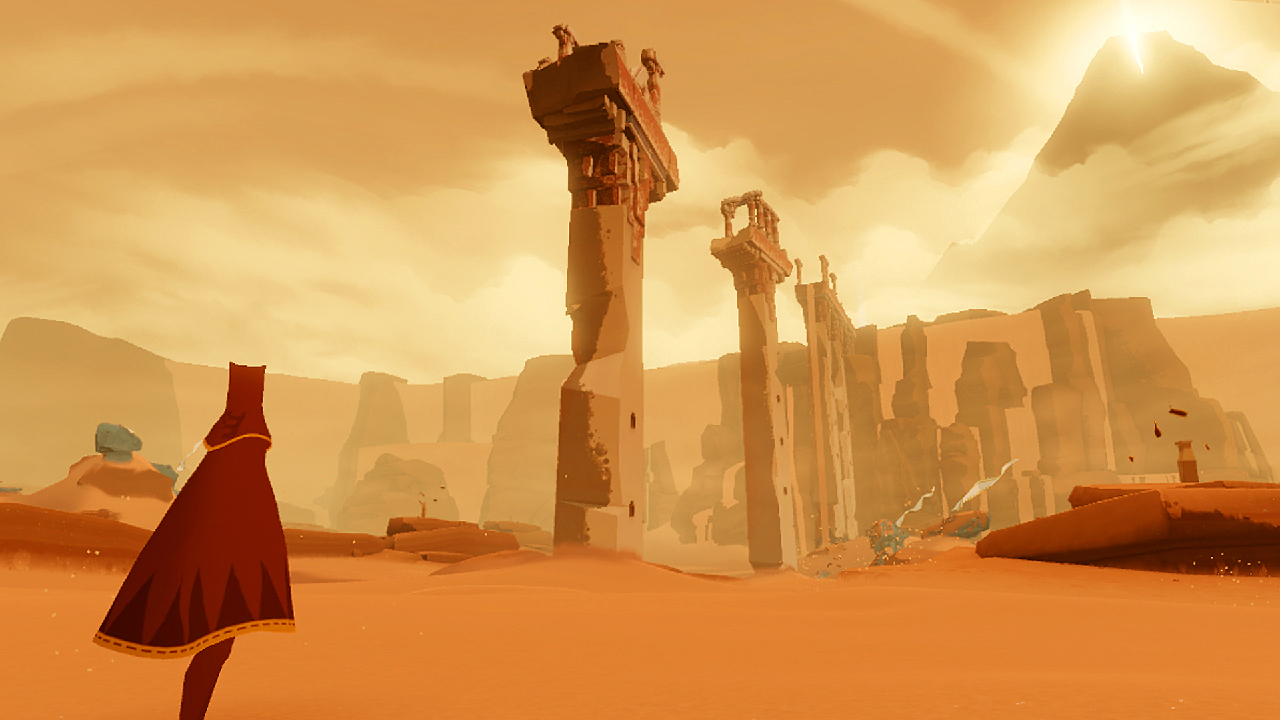
It's a long way to the top.

It’s a long way to the top.

The goal of Journey is to, as the name implies, journey up to the top of a mountain. It’s not as simple as strolling up a mountain. The player learns (or interprets) from the glyphs they find along the way why they are making the journey and what it represents. Controlling the robed figure around the hauntingly desolate desert to reach its goal has an emotional, almost spiritual, demeanor to it. There is certainly a lot of symbolism flowing throughout the game, but that is not necessarily what makes it.

What makes the game great is how That Game Company knew their limitations and pushed what they did have to the limit. Everything about the game is top notch. One can only assume they saw what worked and what didn’t with their previous game, Flower, when making decisions about Journey. When the biggest complaint I can find is the shoehorning of Sixaxis controls that don’t even affect gameplay, I know I have found my game of the year.

The developers did not overstep their boundaries. Instead they took their time and made a concise game that flows buttery smooth from start to finish virtually bug free.

In fact the game is so streamlined and short, it is accessible to people who don’t normally identify themselves as gamers. From the day Journey first arrived in my house I had been avidly showing it off to all kinds of people.

Watching people explore the game and discover their first companion always unfolds differently. Every time I watch someone play I always seem to walk away remembering how that player played that game and what they got from their playthrough. The real replay value for me is sharing the joy Journey brings with other people and living vicariously through their fun.

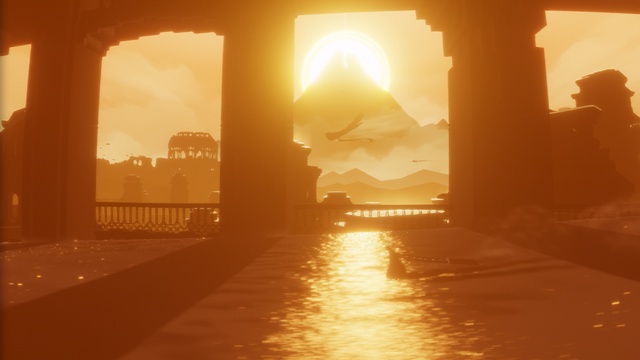
JourneySlide1

Journey is even prettier in motion.

Those who don’t play games find solace in the relatively simple controls, alluring setting and lack of combat. Not having to deal with the pressure of dying helps to draw in people who don’t consider them gamers. Even as an “artsy fartsy” game, it was still enjoyed by fans of all game genres. As a someone who tries to play nearly every game under the sun, it’s great to show off such a critically acclaimed game that is as accessible as Journey. Skyrim would not make the same impression with my mom.

Even as a fairly independent game, Journey is the most gorgeous game to grace my television. But the graphics would not have made the same impact without the musical score done by Austin Wintory. The decision to loop smaller pieces of music together and to make it react to the player’s actions or location is brilliant. Movies play music depending on what characters are doing so why not games as well? Between that and using a cello as a theme throughout the game, Journey’s music left me with a lasting impression as strong as the game itself.

Journey is one of the most important games of this generation. Beauty, functionality and innovation come together in an independent downloadable title that a wide variety of people can enjoy.

Besides that, the game is simply fun. Sliding and flying through the wondrous landscapes is a joyous experience that is unavailable on any other game this year. It’s an extraordinary experience that I wish everyone will give a chance.

GOTY 2012 — Ricardo: The Walking Dead

2012 was an odd year for me and games. Where oftentimes I find myself struggling to narrow down my ten favorite releases, this year I’m stumped to find even five games I can muster great enthusiasm for; certainly a symptom of my own increasing cynicism and not the quality of releases… at least I’m willing to assume.

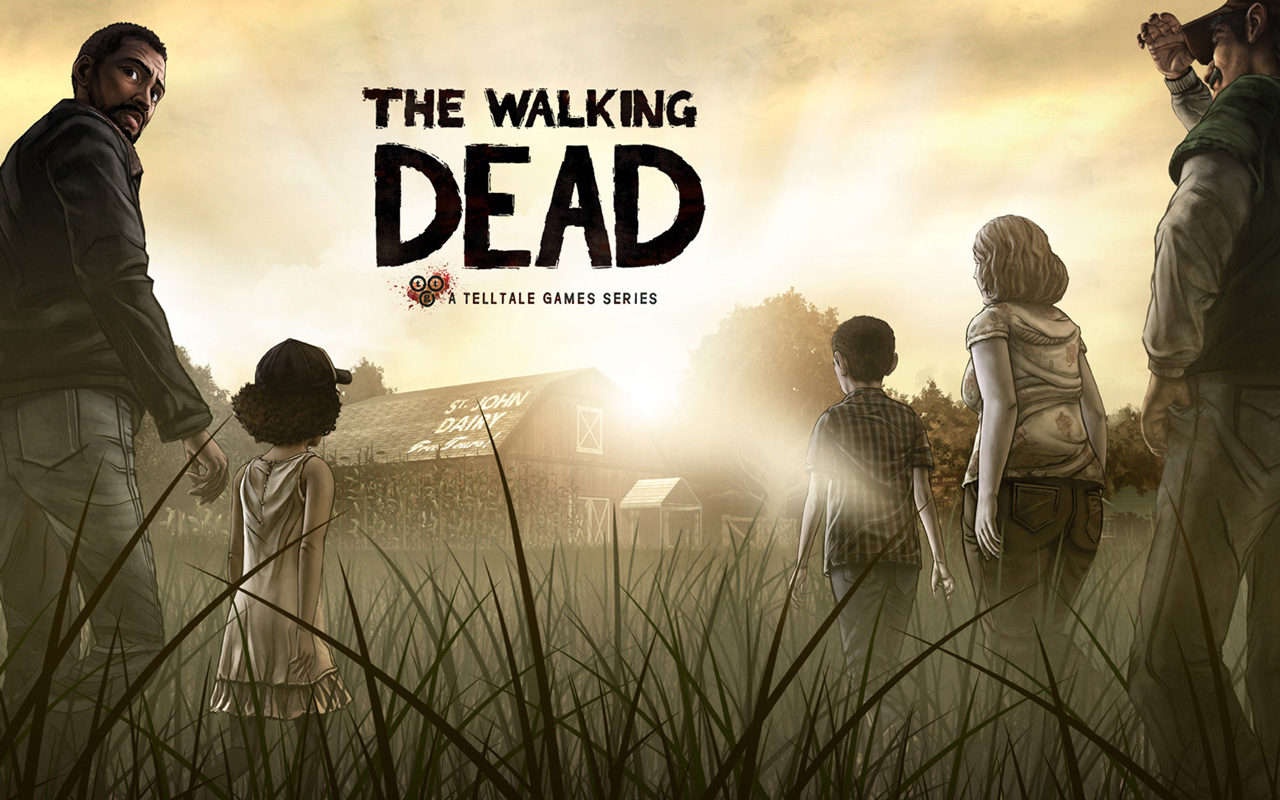
Ricardo’s 2012 Game of the Year: The Walking Dead

One game that had my complete and utter enthusiasm, however, was Telltale Game’s The Walking Dead. Well, perhaps “enthusiasm” is not the correct terminology — what constitutes enthusiasm in The Walking Dead is when the game allows fifteen minutes to pass without having something terrible befall one of the characters it’s spent such time making you love.

And the storytelling here is most certainly ace, but to that games have never really told a story the way this episodic game told its story is not necessarily true. Bioware has done a good job delivering that “tailored experience” before with its Mass Effect and Dragon Age games; Fable (however horribly disappointed I am with it as a series) has delivered entire worlds that react and change to your actions.

The difference is these games have always made sure these elements work in service to the game play, and not the other way around. After all, these are “games,” right? They need to have an additional hook outside of just, “it tells a really good story,” don’t they?

The Walking Dead suggests otherwise.

Telltale’s team has flipped the proverbial script and made a game where presentation and game play are both slavishly in servitude to its story. By putting a time constraint on every question from “How are you feeling?” to “Who needs to live and who needs to die,” the game inserts you directly into the pressure, the conflict and the uncertainty of its characters’ world.

You are, for all intents and purposes, Lee Everett. It is you, not Telltale, who decides what kind of person you will be in this nightmare. You will do this with decisions, not actions, and just what you decide might reveal more about yourself than you might care to know. This is a depressing tale, and it’s one that is not for the faint of heart.

Again, The Walking Dead does all this not with soul-crushing difficulty or addiction-fueling multiplayer. It does this with story. I could go on and on about the quality of the voice-acting and the way I loved how the game’s presentation worked in service of its graphical limitations and not against it- hell, I could even go on and on about its faults — but I fear I’d be getting off point.

The social interactions in The Walking Dead make that game.

The point is this: In sea of sameness and in a medium where how many hours you can squeeze out of an already soulless experience is somehow valued over how much fun or how impactful of an experience a game offers, The Walking Dead stands as the most memorable gaming experience I had in 2012. It is an experience unlike anything available anywhere else, even in video games.

Like Bastion in 2011, it is the game that left the biggest emotional impression on me and on the way I look at games; a year where I struggle to remember ten games that left me with anything to ponder has five of its slots filled by all five episodes of this extraordinary story.